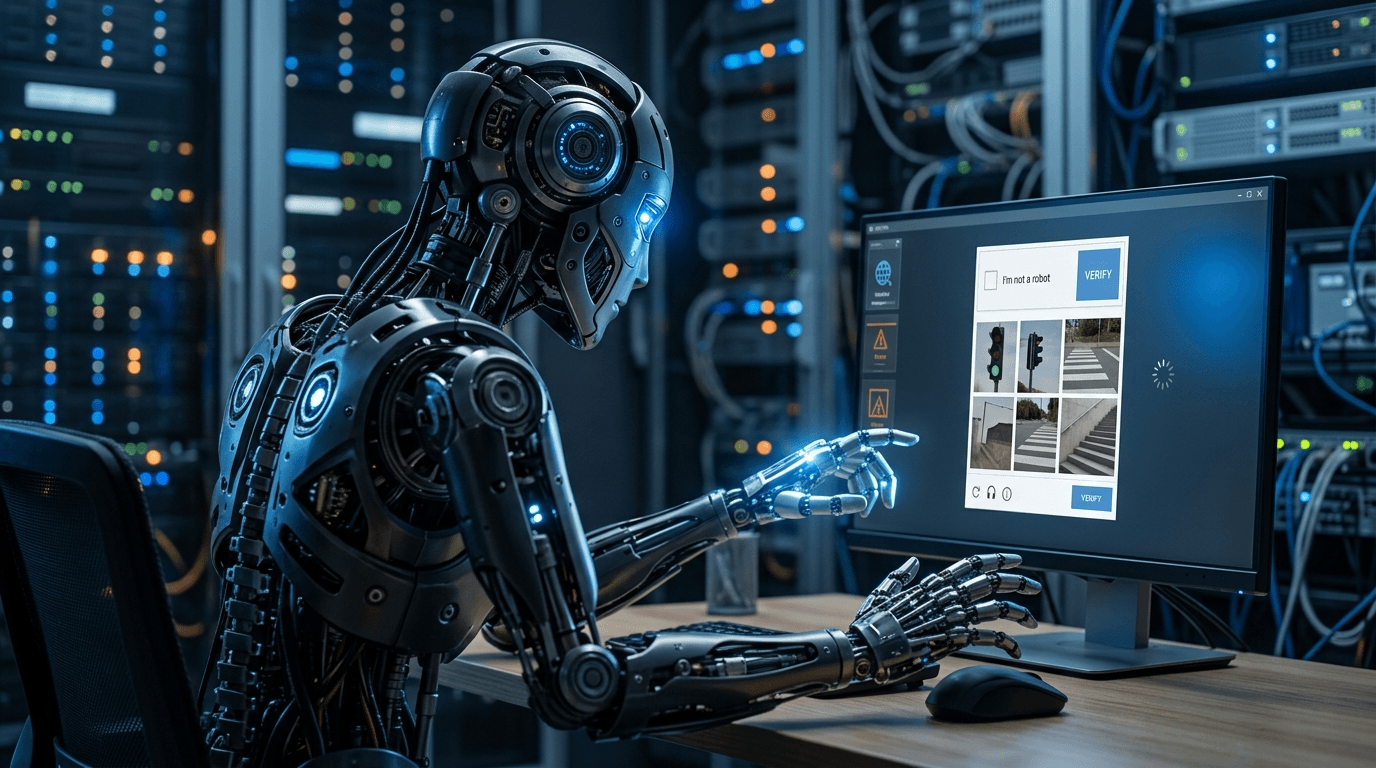
The Death of the "Mechanical Turk" and the Rise of the Agentic Era
For two decades, Amazon Mechanical Turk (MTurk) stood as a strange, liminal space in the evolution of technology. It was a marketplace where humans were paid fractions of a cent to do what machines couldn't: identify a stop sign in a grainy photo, transcribe a snippet of audio, or determine if a sentence sounded "angry."
The recent announcement that Amazon will stop accepting new customers for Mechanical Turk by July 30, 2026, isn't just a corporate sunsetting of an old product. It is a symbolic burial. It marks the end of the "Human-in-the-Loop" era as a makeshift patch for technical limitations and signals the definitive arrival of Agentic AI.
The Great Irony: When Humans Became the Bots
The history of Mechanical Turk is rooted in a hoax. The original 18th-century "Turk" was a fake chess-playing machine with a human hidden inside. For years, many modern AI companies operated on this same principle—a practice often called "Wizard of Oz-ing." They marketed products as "AI-powered" while secretly employing legions of MTurk workers to manually process data in the background.
But as Large Language Models (LLMs) evolved, a recursive irony emerged. Recent data showed that nearly half of the workers on MTurk were using AI to complete their tasks. We reached a surreal tipping point: humans were being paid to do tasks that they were outsourcing back to AI.
When the "human bridge" between raw data and machine intelligence becomes an automated loop, the bridge is no longer necessary. The tool didn't just break; it became obsolete because the goal—autonomous intelligence—was finally achieved.
From Passive Chatbots to Digital Employees
For years, businesses tried to replace these manual processes with chatbots. But traditional chatbots were just glorified FAQ pages—passive systems that could tell you how to track an order but couldn't actuallytrack it for you without sending you to another link. They provided information, but they didn't perform work.
This is where the paradigm shifts from Conversational AI toAgentic AI.
The decline of crowdsourced micro-tasks proves that we no longer need thousands of humans to manually label data or trigger simple workflows. Instead, we need agents that possess three critical capabilities:
- Domain Expertise: Knowing the specific rules and nuances of an industry (e.g., e-commerce vs. healthcare).
- Tool Proficiency: The ability to interact with APIs, CRMs, and databases via protocols like MCP (Model Context Protocol).
- Proactivity: Moving beyond "question-answer" cycles to initiate actions based on triggers (e.g., reaching out to a customer who abandoned their cart).
The New Standard: The Digital Worker
At Giizo AI, we view the sunsetting of Mechanical Turk as validation of our core philosophy: AI should not be an infrastructure; it should be a strategic partner.
We aren't building chatbots; we are deploying digital employees. While MTurk represented fragmented human labor used to fill gaps in software, Agentic AI represents integrated digital labor that drives business outcomes autonomously.
Imagine the difference:
- The Old Way (MTurk/Chatbot): A customer asks about an order $\rightarrow$ A chatbot provides a link $\rightarrow$ Or worse, a human worker manually checks a database and updates a status $\rightarrow$ Customer waits hours for an email.
- The Agentic Way (Giizo AI): A customer asks on WhatsApp $\rightarrow$ An AI agent uses its toolset to query the live shipping API $\rightarrow$ It provides the real-time location $\rightarrow$ It proactively notifies the customer when the package is two blocks away—all without any human intervention required in the loop.
Embracing Autonomy over Approximation
The era of "faking it until you make it" with hidden human labor is over because we can finally make it. The transition from crowdsourcing simple tasks to deploying specialized agents allows businesses to scale without linearly increasing their headcount or relying on unreliable third-party taskers.
Whether it is an E-commerce Sales Agent managing returns or a Clinic Appointment Agent optimizing schedule slots, the goal is no longer just "automation"—it is agency.
Amazon Mechanical Turk served its purpose as a stepping stone toward artificial intelligence. But as we move toward July 2026 and beyond, we aren't just losing a platform; we are gaining an era where business processes are executed by intelligent agents who don't just talk about work—they actually do it.