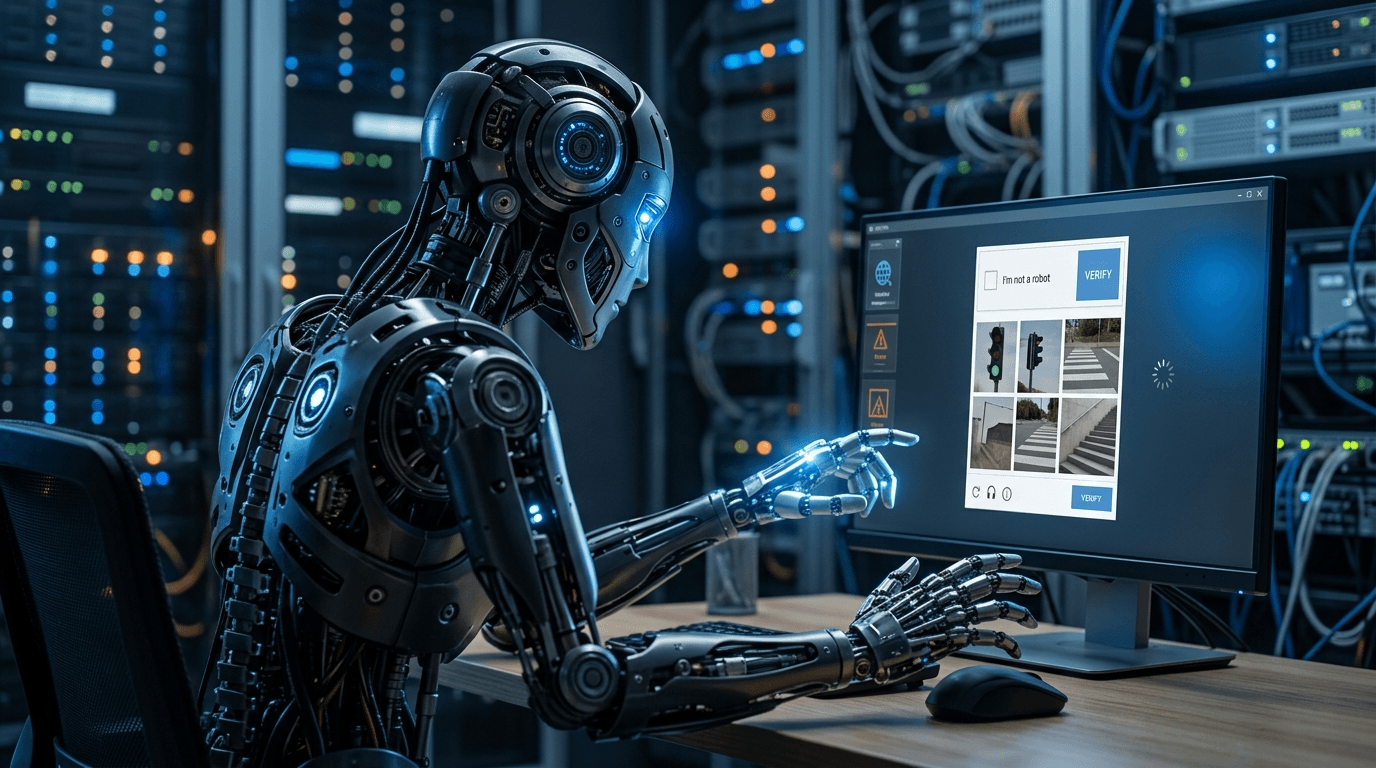
From Chatbots to Digital Colleagues: The Era of Autonomous AI Agents
For years, the business world has been enamored with "chatbots." We remember them as rigid decision trees—digital receptionists that could answer three pre-set questions and then stubbornly suggest, "I'm sorry, I didn't understand that. Please contact a human agent."
But we have crossed an invisible threshold. We are no longer talking about bots that simulate conversation; we are entering the era of AI Agents—digital entities that execute work.
The recent industry shift toward "automated research interns" and self-improving systems isn't just a win for big tech labs; it is a blueprint for how every modern business will operate in the next 24 months. The core transition is simple but profound: moving from Information Retrieval (telling you something) toTask Orchestration (doing something for you).
The Anatomy of a Digital Employee
What separates a sophisticated chatbot from a true AI Agent? It comes down to three critical capabilities: Reasoning, Tool Use, and Memory.
Imagine a customer reaches out via WhatsApp saying, "My last order arrived damaged; can I exchange it for a blue one in size M, and where is my other pending shipment?"
A chatbot would likely provide a link to the return policy. An AI Agent, however, performs "Task Orchestration":
- Analyzes the intent: It identifies two distinct tasks (exchange request + shipping status).
- Calls the tools: It connects to the e-commerce API to verify the order, checks the real-time inventory for the blue size M, and queries the cargo tracking system.
- Executes the workflow: It initiates the return process in the CRM and provides a precise delivery date for the second package.
- Delivers one cohesive answer: The customer gets a resolution, not a set of instructions on how to find one.
This is no longer science fiction; this is how Giizo AI operates today. By integrating RAG (Retrieval-Augmented Generation) with MCP (Model Context Protocol), agents stop being "text generators" and start being "action takers."
The Power of Recursive Growth: Agents That Learn on the Job
The most exciting frontier in AI isn't just what an agent can do on Day 1, but how much better it becomes by Day 100. In traditional software, if a bot fails, a human must manually rewrite its code or prompt.
The future belongs to Learning Systems. Imagine an agent that analyzes its own successful interactions—the conversations where customers gave high ratings—and extracts "behavioral principles" from them. If it discovers that offering a complementary product during an exchange request increases customer satisfaction by 20%, it doesn't wait for a manager to tell it so; it internalizes this as a new skill.
This creates a virtuous cycle:
- Successful Interaction $\rightarrow$Skill Extraction $\rightarrow$Improved Performance $\rightarrow$Higher Success Rate.
When your digital employee learns your specific industry nuances and your customers' unique preferences through actual experience, they cease to be generic software and become a proprietary asset of your company. Your competitive advantage is no longer just your product—it’s the collective intelligence of your autonomous workforce.
Beyond Reaction: Proactive Autonomy
Until now, AI has been reactive: you ask, it answers. But true agency requires proactivity. This is where "Smart Automation" changes the game.
A proactive agent doesn't wait for a trigger from the user; it monitors triggers from the business. For example:
- Inventory Trigger: An agent notices stock levels for a best-seller have dropped below 10%. Instead of just alerting you, it drafts an order for the supplier and sends you a notification: "Stock is low; I've prepared the purchase order for your approval."
- Customer Lifecycle Trigger: An agent identifies users who abandoned their carts three days ago and sends personalized follow-ups based on their browsing history across Instagram or WhatsApp.
This shifts the human role from "Operator" to "Architect." You no longer manage every interaction; you define the goals, set the guardrails (the safety protocols), and oversee the results while your agents handle the operational grind 24/7 across all channels simultaneously.
The New Human-AI Partnership
As we move toward more autonomous systems—from interns to full researchers—the fear of replacement often surfaces. However, history shows that automation doesn't eliminate work; it elevates it.
By delegating "well-defined research tasks," data retrieval, and repetitive coordination to AI agents, humans are freed to focus on what machines cannot do: high-level strategy, emotional intelligence, ethical judgment, and creative vision. The goal isn't an office without people; it’s an office where people are no longer bogged down by administrative friction because they have an army of tireless digital colleagues handling everything else.
The transition from chatbot to agent is not just a technical upgrade—it is an organizational evolution. Those who adopt this agency today aren't just installing software; they are scaling their capacity to grow without linearly increasing their overhead_.