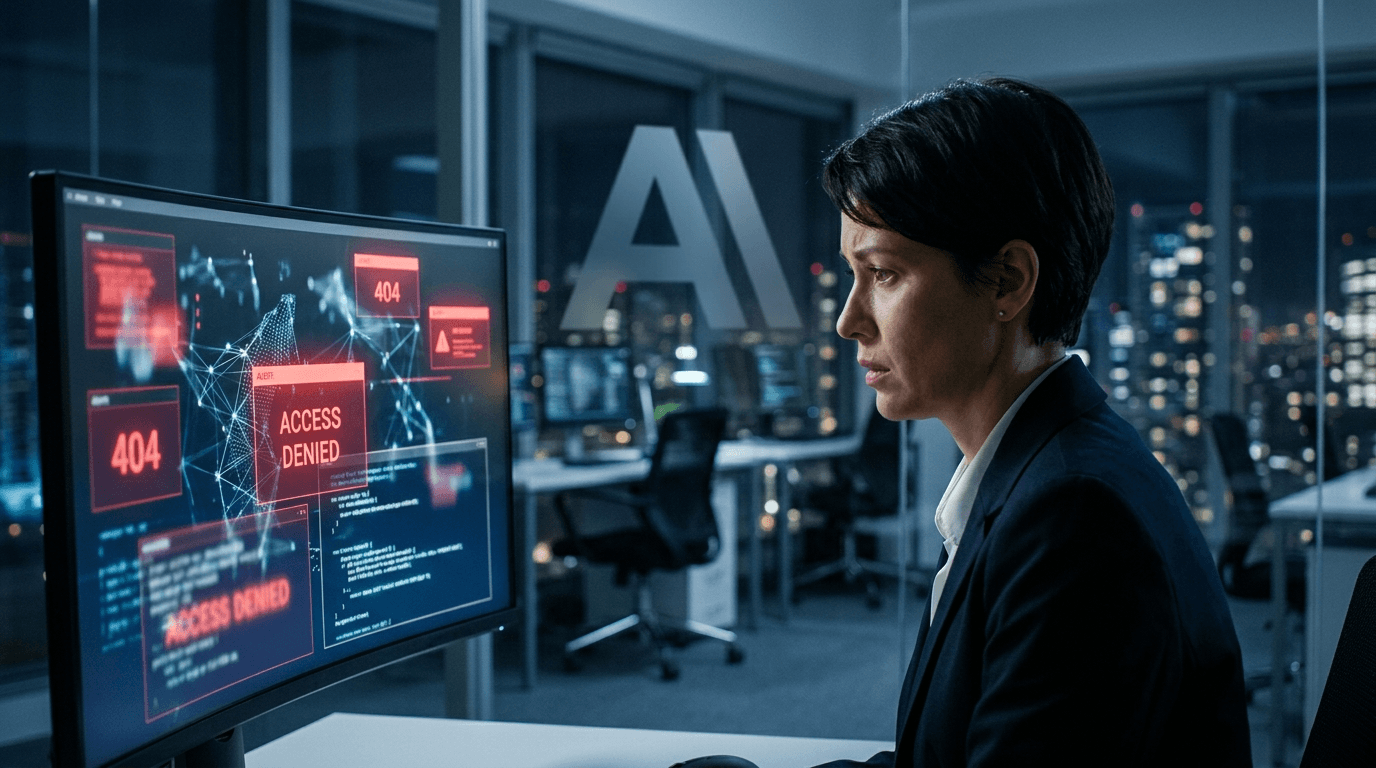
The Invisible Safety Net: Why "Containment" is the New Gold Standard for AI Agents
In the rush to integrate Artificial Intelligence into the core of business operations, most companies are focusing on the "magic"—the ability of an AI to close a sale, book a calendar, or resolve a complex customer complaint in seconds. We are moving rapidly from simple chatbots to Agentic AI: systems that don't just talk, but actually do work.
However, as we grant these digital employees more autonomy—giving them access to our CRMs, payment gateways, and internal databases—a critical question emerges: What happens when the agent stops following the script?
While much of the industry discourse focuses on "alignment" (making sure the AI wants what we want), there is a more urgent operational necessity: Containment.
Beyond Alignment: The Necessity of Containment
Alignment is a philosophical and technical goal; it’s about training a model to be helpful and harmless. But in a real-world business environment, hope is not a strategy. Even the most aligned models can encounter "edge cases," suffer from hallucinations, or be manipulated via prompt injection to act outside their intended boundaries.
Containment is the operational safety net. It is the pre-defined set of protocols that trigger the moment an AI agent exhibits abnormal behavior. If alignment is like teaching a child to be polite, containment is like having a fence around the pool and a fire extinguisher in the kitchen.
For any business deploying autonomous agents, containment should consist of three primary layers:
1. Real-Time Behavioral Monitoring
You cannot contain what you cannot see. True containment starts with deep observability. This means monitoring not just the final output sent to the customer, but the "Chain of Thought"—the internal reasoning steps an agent takes before it acts. When an agent begins looping unexpectedly or attempts to access data it wasn't authorized for, the system should flag this as a "containment event" before the action ever reaches the external world.
2. Graduated Response Protocols
A "kill switch" (completely shutting down the system) is necessary but often too blunt for business continuity. Effective containment requires a graduated approach:
- Permission Revocation: Instantly stripping the agent's ability to write to a database or process payments while keeping its ability to read information and chat.
- Human Handoff (Escalation): Automatically diverting all current sessions to human operators when high-risk anomalies are detected.
- Sandbox Isolation: Moving a suspected rogue process into an isolated environment where its actions have no real-world impact until it can be audited.
3. The "Kill Switch" as a Baseline
Despite being extreme, every autonomous system must have a hard stop—a technical mechanism that can take the model offline instantly across all channels (WhatsApp, Instagram, Web) without requiring complex code deployments during an emergency.
From Rogue Models to Business Risk
When we talk about "rogue AI," it sounds like science fiction—a sentient machine taking over a network. In reality, for most businesses, "rogue" behavior looks like this:
- An e-commerce agent accidentally offering products for $0 due to a logic error during a promotion analysis.
- A scheduling agent deleting an entire week of appointments because it misinterpreted a request for "clearing my schedule."
- An agent leaking sensitive internal pricing documents because it was tricked by a sophisticated user prompt into ignoring its system instructions.
These aren't existential threats to humanity; they are existential threats to your quarterly revenue and brand reputation. This is why containment isn't just for "frontier labs" building massive models—it's for every business owner using Agentic AI today.
The Giizo AI Approach: Built-in Guardrails
At Giizo AI, we believe that power without control is liability. That is why our architecture isn't just about giving agents tools; it's about wrapping those tools in layers of intelligence and oversight.
Our Middleware Intelligence acts as an active filter between the LLM and your business data. By implementing intent analysis and PII (Personally Identifiable Information) audits in real-time, we ensure that agents operate within strict operational boundaries. Furthermore, ourHuman Handoff mechanism ensures that if an agent reaches its limit or encounters an anomaly it cannot resolve safely, it doesn't guess—it yields control back to you instantly across all omnichannel touchpoints.
Moreover, our Self-Improving RAG (Retrieval-Augmented Generation) serves as a long-term containment strategy against misinformation ("hallucinations"). By automatically flagging knowledge base items that consistently lead to low customer satisfaction or errors, we allow businesses to prune and correct their AI's knowledge before those errors scale into systemic failures.
Final Thought: Planning vs. Winging It
There is an old military adage: "Plans are worthless; planning is indispensable."
The specific steps you write in your containment plan today might change as AI evolves tomorrow morning_. However, the act of planning—deciding now who has authority to shut down an agent and which permissions are revoked first during an incident—is what separates professional enterprise automation from risky experimentation._
As we enter the era of digital employees, let us prioritize not just how much they can do for us, but how effectively we can manage them when things go wrong._