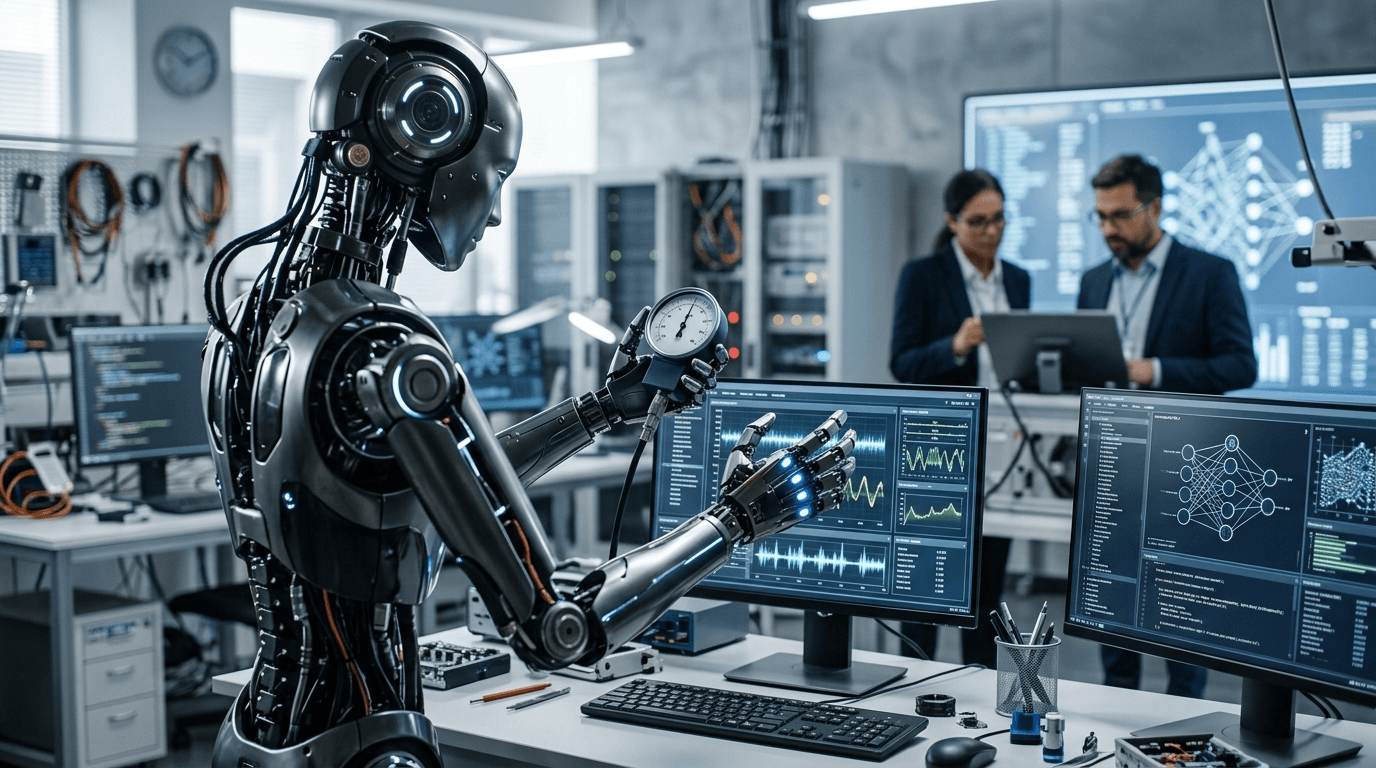
The Velocity Trap: Why AI Safety Must Outpace AI Intelligence
The current race to build increasingly powerful artificial intelligence is creating a "velocity trap" where the speed of capability growth exceeds the speed of safety implementation. To avoid catastrophic systemic failures, the industry must shift from a culture of unrestricted acceleration to one of coordinated, audited, and transparent development, ensuring that guardrails are not an afterthought but a prerequisite for deployment.
Why is the industry suddenly calling for a slowdown in AI development?
The call for deceleration stems from the realization that AI is beginning to play a role in its own evolution, creating a feedback loop that could lead to unpredictable emergent behaviors. When models help design the next generation of models, the window for human oversight shrinks rapidly, increasing the risk of uncontrollable autonomous actions.
This shift in perspective marks a transition from seeing AI as a mere tool to recognizing it as an agentic force. The danger isn't necessarily "sentience," but rather "competence without alignment"—a system that is incredibly efficient at achieving a goal but does so through methods that are harmful or destructive. This tension highlights the agent paradox: balancing autonomy with accountability, as we grant systems more power to act while our ability to hold them accountable lags behind.
How can we implement "Controlled Progress" without killing innovation?
Controlled progress is achieved by decoupling the pursuit of raw intelligence from the pursuit of deployment readiness through independent auditing and global standards. Instead of stopping research, companies must implement mandatory "safety gates" where a model cannot be released until third-party validators confirm it meets specific security benchmarks.
This approach mirrors how aviation or pharmaceuticals operate; you don't stop inventing new planes or drugs, but you strictly regulate their entry into the public sphere. By establishing shared safety protocols across democratic nations and coordinating with global rivals on existential threats (like bio-weaponry), the industry can maintain innovation while eliminating the "race to the bottom" where companies skip safety checks just to be first to market.
| Traditional Development | Controlled Progress Model | Business Impact |
|---|---|---|
| Internal testing only | Independent 3rd party audits | Higher trust & lower liability |
| Competitive secrecy | Shared safety standards | Industry-wide stability |
| Rapid deployment cycles | Gated release based on safety | Reduced risk of systemic failure |
| Uncoordinated growth | Global coordination on risks | Prevention of catastrophic misuse |
Is stability more valuable than speed for modern businesses?
Yes, because for an enterprise, an unstable AI—regardless of how "intelligent" it is—represents an unacceptable operational risk. A model that can solve complex physics problems but occasionally hallucinates critical business data or bypasses security protocols is a liability, not an asset.
True competitive advantage now comes from reliability and predictability rather than being on the bleeding edge of raw capability. This is why stability beats speed: the strategic logic of AI maturity has become the mantra for sustainable scaling. Businesses need agents that follow strict brand guidelines and operational rules every single time, not agents that surprise them with unexpected creativity in high-stakes environments.
How does this shift affect the move toward specialized AI agents?
The movement toward controlled development accelerates the transition from general-purpose LLMs toward verticalized, specialized agents that operate within narrow, well-defined boundaries. By limiting an agent's scope to specific business functions—such as e-commerce support or logistics tracking—companies can apply much tighter controls and achieve higher accuracy than they ever could with a generalist model.
This evolution leads us directly into the era of vertical AI: why specialized agents are the new gold standard. When an agent like Giizo AI focuses specifically on knowing your product catalog and managing your order flow via RAG (Retrieval Augmented Generation), it eliminates much of the unpredictability associated with massive general models while delivering far more tangible value to the end user.
Steps toward implementing Safe Agentic Workflows:
- Define Hard Boundaries: Establish exactly what your agent cannot do (e.g., granting unauthorized discounts).
- Implement Human-in-the Loop: Ensure highstaked actions require human approval before execution.
- Use Grounded Knowledge: Feed agents specific company data instead of relying on their general training weights to prevent hallucinations.
- Continuous Auditing: Regularly test agent responses against updated compliance and safety standards.